Comparative Cost Analysis of Mark Cuban Cost Plus Drugs Pricing for Commercial Payers
This study presents a comprehensive analysis of Mark Cuban Cost Plus Drug Company (MCCPDC) pharmaceutical pricing compared to traditional pharmacy benefit manager (PBM) pricing structures. Using claims data from just over a dozen employer groups, we evaluate MCCPDC’s cost-plus pricing model on addressable claims (i.e., those with a MCCPDC price available) across multiple aspects, including drug type, days supply, as well as a comparison to National Average Drug Acquisition Cost (NADAC) benchmark.
Our analysis reveals that MCCPDC achieved an average price reduction of 67% compared to gross PBM charges for the same drugs, with total savings of $42 million. While MCCPDC pricing showed higher costs for low-cost generic claims below $10.40, substantial savings were observed on higher-cost medications, particularly bioequivalent products where savings reached 93%
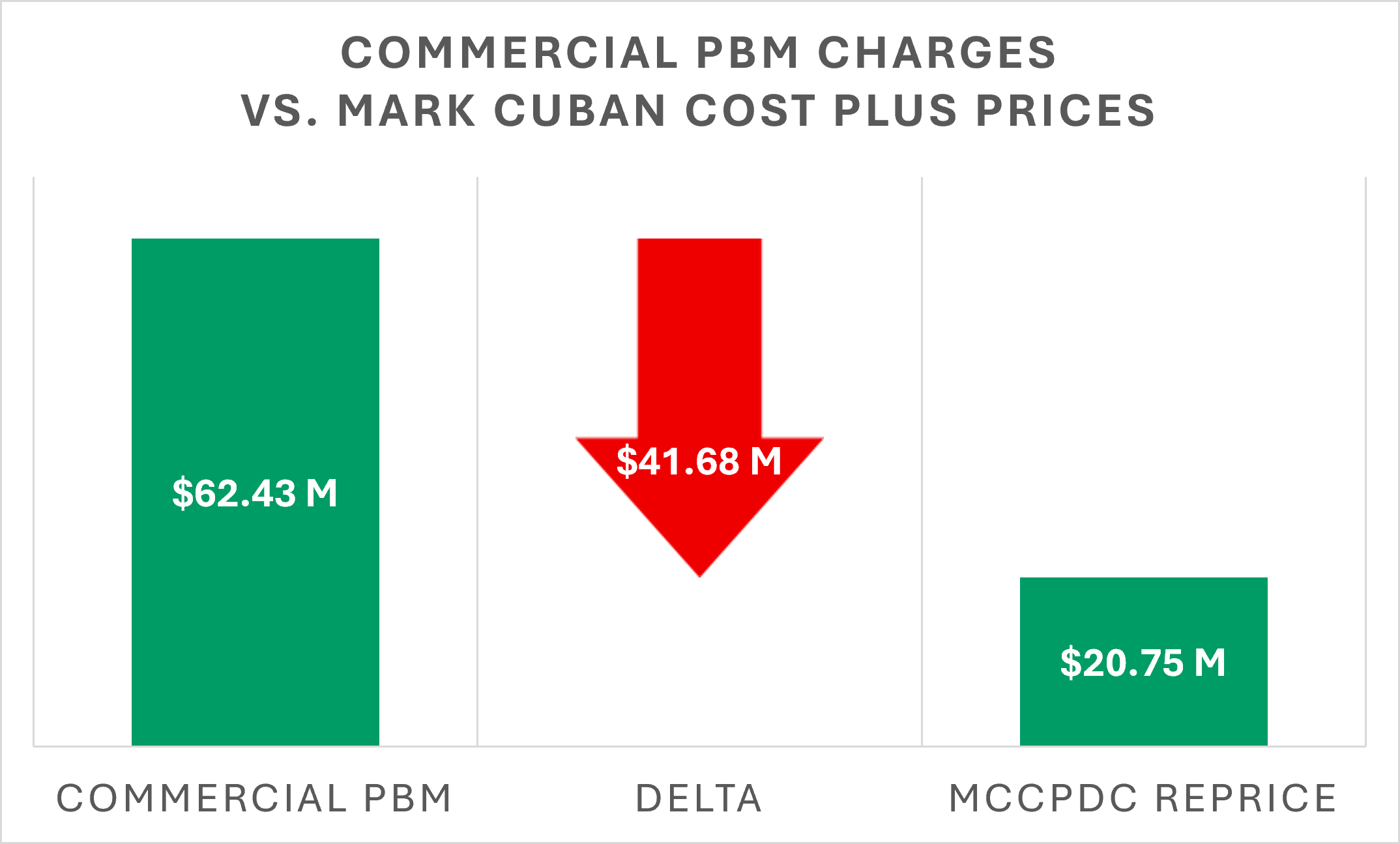
While the overall savings are significant (nearly 10% of drug spending), the savings analysis was segmented by drug type to identify the primary sources of cost reduction. While MCCPDC provided aggregate savings across all drug categories, the most significant savings were achieved with bioequivalent medications, where $30.69 million in savings occurred, representing 73.6% of total savings

The study reveals significant savings for bioequivalent and brand drugs (93% and 32% reduction of current charges, respectively); however, interpreting these figures is complicated by the absence of readily available rebate data for these categories within the commercial PBM plan sponsor data.
Brand medications — including biologic products such as Humira and Stelara — typically carry manufacturer rebates that are passed back, in whole or in part, to employers via PBM contracts. The value of brand rebates can represent hundreds to thousands of dollars in aggregate value per claim. Without payer-specific rebate data, we cannot directly compare net PBM cost to MCCPDC pricing for these products. That being said, the magnitude of the observed MCCPDC savings sets a useful benchmark for how large a rebate would need to be to close the observed gap. For Humira and Stelara specifically, matching MCCPDC's savings on a like-for-like basis would require rebates of roughly $11,000 per claim — equivalent to a 93% reduction off current charges. While brand and biologic rebates can be substantial, they rarely approach this magnitude in practice, suggesting that even accounting for unobserved rebates, MCCPDC pricing likely retains a meaningful cost advantage for these products that in addition to the lower price, benefits can include cash-flow advantages due to not waiting for retrospective rebates to be collected and passed through.
But while rebates can confound analyses of brand drugs, generic drugs are a different story, where apples to apples comparisons are more readily possible. In this case, MCCPDC provided average savings of 37% vs legacy commercial PBM-negotiated rates, underscoring the systemwide potential for cost-plus pricing models like those utilized by MCCPDC to lower prescription drug expenditures. These findings suggest significant opportunities for cost-plus pricing models to reduce pharmaceutical expenditures for commercial health plans.
At 3 Axis Advisors, we understand that health care is unnecessarily complex and exceedingly expensive. With precious financial resources and the care of our loved ones on the line, we believe that through a better comprehension of our system’s mechanics and incentives, a better healthcare system is possible.
Driven by our experience, innate curiosity, and passion for finding truth, we expose and simplify inefficiencies and cost-drivers in the prescription drug supply chain and work to remedy them through data-driven research and innovative solutions.
We hope that the insights contained in this report can build upon previous drug pricing research and help to better shorten the bridge between understanding and misunderstanding the nuances of the prescription drug supply chain.
A big thanks to Mark Cuban Cost Plus Drug Company for publishing their drug pricing data and for their support and sponsorship of this important drug pricing research.
Coverage
How Mark Cuban's drug prices compare to corporate-owned pharmacies
USA TODAY, 10/8/26